Park Icons Set: Flat Style for Modern UI Design
In the fast-paced world of digital design, clarity often wins over complexity. When building user interfaces for websites or mobile applications, every pixel counts, and every visual element must communicate its purpose instantly. This is where a well-crafted Park Icons Set, Flat Style becomes an indispensable asset. These universal park icons are not merely decorative; they are functional tools designed to streamline navigation, enhance storytelling, and create a cohesive visual language across various platforms. Whether you are a seasoned UI designer, a marketing professional launching a local tourism campaign, or an educator creating interactive learning materials, leveraging high-quality vector illustrations can elevate your project from good to exceptional.
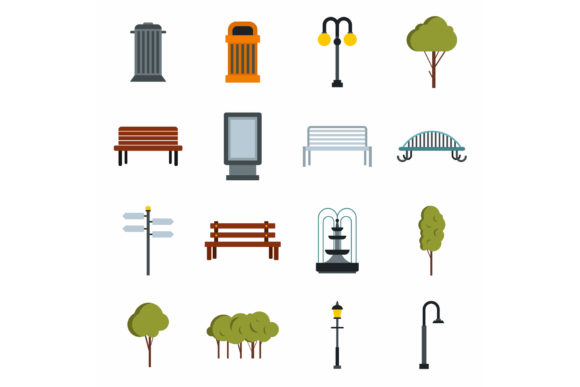
The appeal of flat design lies in its simplicity. By stripping away unnecessary gradients, shadows, and textures, flat icons focus on shape and color to convey meaning. A flat park icons set typically includes essential elements like benches, trees, fountains, playground equipment, and pathways, all rendered with clean lines and vibrant, solid colors. This aesthetic aligns perfectly with modern design trends that prioritize speed, readability, and responsiveness. Because these assets are provided as isolated vector illustrations, they offer unparalleled flexibility. You can scale them up for a billboard or down for a smartwatch interface without losing a shred of quality.
Versatility Across Digital Platforms
One of the primary strengths of using a comprehensive icon library is its adaptability. The formats included—JPG, EPS, AI, PSD, and PNG—ensure that no matter what software stack you rely on, you have the right file for the job. For web developers working directly in code, the PNG files with transparent backgrounds allow for immediate implementation in HTML and CSS. Meanwhile, designers using Adobe Illustrator or Photoshop can dive into the AI, EPS, or PSD files to customize colors, adjust strokes, or combine elements to create unique compositions.
Consider the needs of a mobile app developer creating a guide for city parks. The interface requires intuitive navigation markers. A flat style icon of a picnic table or a restroom facility is instantly recognizable, reducing the cognitive load on the user. Unlike realistic images which can look cluttered at small sizes, flat icons remain crisp and legible even on high-density Retina displays. This consistency is crucial for maintaining a professional look and feel throughout the application.
Furthermore, these icons are not limited to screen-based media. Marketers and small business owners can utilize the vector formats (EPS and AI) for print collateral. Imagine a community newsletter, a printed map for a nature reserve, or promotional flyers for a summer festival. The ability to edit the vector paths means you can match the icon colors exactly to your brand guidelines, ensuring a unified identity across both digital and physical touchpoints.
Creative Applications and Project Ideas
The utility of a Park Icons Set, Flat Style extends far beyond standard wayfinding. Creative professionals can interpret these basic elements in numerous ways to serve different goals. Here are several practical approaches to integrating these assets into your workflow:
- Interactive Maps and Wayfinding: Build custom maps for municipal websites or hiking apps. Use the icons to denote points of interest such as water fountains, dog parks, or bike rental stations. The flat style ensures the map remains uncluttered, allowing users to find information quickly.
- Educational Content: Educators and publishers can use these illustrations to create engaging materials for children. Flashcards teaching vocabulary about nature, interactive quizzes about park safety, or storybooks featuring outdoor adventures become visually appealing when paired with consistent, friendly iconography.
- Infographics and Data Visualization: Environmental agencies or non-profits can leverage these icons to visualize data regarding green spaces. For instance, an infographic showing the increase in urban tree planting can use the tree icons as data points, making complex statistics accessible and engaging for the general public.
- Event Branding: Freelancers organizing local events like marathons, yoga in the park, or food truck festivals can use these elements to build a thematic brand identity. The icons can be adapted into patterns for merchandise, backgrounds for social media posts, or headers for event landing pages.
Customization for Brand Consistency
While the default colors in a flat icon set are often chosen for their visual harmony, true professionalism comes from adaptation. A generic blue bench might work for a public utility site, but a boutique landscape architecture firm would benefit from recoloring that same bench to match their corporate palette. Because the files are vector-based, changing the fill color is a trivial task. This level of customization allows creators to maintain originality while relying on pre-made assets to save time.
It is also worth noting the importance of consistency in stroke weight and corner radius. When mixing icons from a set, ensure that the visual weight remains uniform. If you decide to modify an icon, such as adding a specific logo to a signpost within the illustration, pay attention to the line thickness of your addition so it blends seamlessly with the existing style. This attention to detail separates amateur designs from polished, professional work.
Optimizing Workflow and Performance
For entrepreneurs and hobbyists working with limited resources, efficiency is key. Downloading a complete set of universal park icons eliminates the need to search for individual graphics across multiple stock sites, which often results in a mismatched visual style. Having a centralized library of assets accelerates the prototyping phase. You can drag and drop elements into your wireframes to test layout concepts before committing to final designs.
From a technical standpoint, using SVGs (which can be exported from AI or EPS files) offers significant performance benefits for web projects. SVGs are code-based, meaning they load faster than raster images and can be animated using CSS or JavaScript. Imagine a tree icon that gently sways when a user hovers over it, or a fountain icon with animated water jets. These micro-interactions add a layer of delight to the user experience without compromising load times, a feat easily achievable with vector sources.
Best Practices for Implementation
To get the most out of your icon set, keep the following recommendations in mind:
- Maintain Scale: Always use icons at appropriate sizes. While vectors scale infinitely, the visual balance of a flat icon is usually optimized for specific dimensions. Test your icons at the smallest size they will appear in your UI to ensure they remain distinguishable.
- Use White Space: Flat icons breathe best when surrounded by adequate white space. Crowding them together can diminish their impact and make the interface feel chaotic. Allow the simplicity of the design to shine.
- Accessibility Matters: When using these icons for navigation, always include alt text or ARIA labels. An icon of a trash bin should be accompanied by text or code that identifies it as "Trash" or "Recycling" for screen readers, ensuring your content is inclusive.
- Contextual Relevance: Ensure the icon matches the context. A swing set icon implies play; using it to represent a quiet reading zone would be confusing. Stick to intuitive associations to guide your audience effectively.
Ultimately, a Park Icons Set, Flat Style is more than just a collection of images; it is a toolkit for communication. It empowers creators to build clearer, more engaging, and visually consistent experiences. Whether you are designing the next great fitness app, planning a community garden website, or crafting educational resources, these isolated vector illustrations provide a solid foundation. By understanding how to adapt, customize, and implement these elements thoughtfully, you can create digital products that resonate with your audience and stand the test of time. The beauty of flat design is its enduring relevance; it focuses on the essence of the object, making it a timeless choice for modern communication.