Integrating Flat Lizard Icons into Modern Digital Interfaces
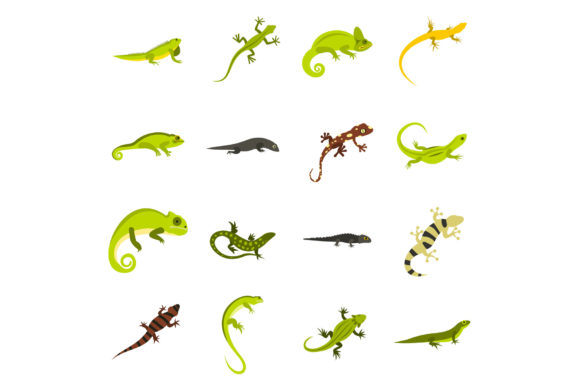
In the rapidly evolving landscape of digital design, the choice of visual assets can significantly influence user engagement and brand perception. Among the myriad of graphic elements available to designers, the Lizard Icons Set, Flat Style has emerged as a versatile and aesthetically pleasing resource for web and mobile UI projects. These universal lizard icons, designed as basic lizard elements isolated in vector illustration formats, offer a unique blend of simplicity and character that resonates with modern design trends. Whether you are a professional UI designer, a hobbyist creating a personal blog, or a business owner looking to refresh your brand identity, understanding the utility and application of these flat-style icons is essential for creating compelling digital experiences.
The Aesthetic Appeal of Flat Design in Wildlife Graphics
Flat design has dominated the interface world for over a decade, moving away from skeuomorphic textures and gradients toward clean lines, bold colors, and simplified shapes. When applied to biological subjects like reptiles, this style strips away unnecessary detail to focus on the essential characteristics of the subject. A flat lizard icons set captures the silhouette, posture, and distinctive patterns of lizards without the visual noise of realistic shading. This approach ensures that the icons remain legible even at small sizes, a critical factor for mobile navigation bars and toolbar buttons.
The use of a Lizard Icons Set, Flat Style allows designers to introduce organic shapes into rigid grid systems without disrupting visual harmony. Lizards, with their elongated bodies, curved tails, and textured scales, provide dynamic forms that break the monotony of standard geometric icons. By utilizing isolated vector illustrations, designers can place these elements on any background color or texture, ensuring seamless integration across different sections of a website or application. The isolation of these elements means there are no bounding boxes or unwanted backgrounds, granting total creative freedom during the layout phase.
Technical Versatility Across File Formats
One of the primary advantages of investing in a high-quality icon set is the range of file formats provided. A comprehensive collection typically includes JPG, EPS, AI, PSD, and PNG files, each serving a specific purpose in the design workflow. Understanding how to leverage these formats is key to maximizing the value of the asset.
- AI and EPS: These vector formats are the backbone of scalable graphics. Created in Adobe Illustrator, these files allow designers to resize the lizard icons to any dimension without losing resolution. This is crucial for responsive web design, where an icon might appear as a tiny favicon on a desktop but needs to scale up for a retina display on a tablet.
- PSD: Photoshop documents are invaluable for designers who need to apply complex layer styles, masks, or blend modes. Having the lizard elements in PSD format facilitates quick prototyping within a raster-based environment.
- PNG: For immediate implementation in web development, PNG files with transparent backgrounds are the industry standard. They ensure crisp edges and compatibility across all browsers and operating systems.
- JPG: While less common for icons due to lack of transparency support, JPG versions are useful for preview galleries, documentation, or contexts where file size is a stricter constraint than background flexibility.
The availability of these diverse formats ensures that the universal lizard icons can be adapted to virtually any technical requirement, from high-fidelity print media to lightweight mobile applications.
Practical Applications in Web and Mobile UI
The utility of a flat lizard icons set extends far beyond simple decoration. In practical terms, these icons serve functional roles that enhance user experience (UX) and convey information efficiently. For educational platforms focusing on biology or ecology, these icons act as intuitive navigational aids. A user scrolling through a module on reptile habitats can instantly recognize a section dedicated to lizards through a recognizable icon, reducing cognitive load and improving information retention.
In the realm of mobile gaming, particularly for casual or puzzle games set in nature, these basic lizard elements can serve as game pieces, collectibles, or status indicators. The flat style ensures that the game interface remains clean and uncluttered, allowing players to focus on gameplay mechanics rather than deciphering complex graphics. Furthermore, for fitness and health applications that utilize animal motifs for progress tracking—such as "unlocking" new levels represented by different species—a lizard icon can symbolize agility, speed, or adaptation.
Business owners in the pet industry or exotic animal conservation sectors can also benefit significantly. A veterinary clinic specializing in exotic pets might use a friendly, flat-style lizard icon on their appointment booking button. This immediately signals their specialty to potential clients browsing on mobile devices. Similarly, conservation NGOs can use these universal symbols in infographics to illustrate population data or habitat ranges, making complex data more accessible to the general public.
Enhancing Brand Identity with Unique Symbols
In a saturated digital market, brand differentiation is paramount. While many companies rely on generic icons found in free libraries, utilizing a specialized Lizard Icons Set, Flat Style can provide a unique visual signature. If a brand's mascot or logo incorporates a reptile, having a matching set of UI icons ensures consistency across all touchpoints. This cohesive visual language strengthens brand recall and professionalism.
Consider a tech startup named "GeckoTech" that focuses on agile software development. Using a set of flat lizard icons throughout their dashboard—representing speed, climbing (growth), and adaptability—reinforces their brand narrative without the need for excessive text. The isolated nature of the vector illustrations allows the brand to recolor the icons to match their specific hex codes, ensuring perfect alignment with their corporate identity guidelines.
Workflow Integration for Designers and Developers
For professionals integrating these assets into their workflow, the process begins with selecting the appropriate format based on the project stage. During the wireframing and mockup phase, designers often prefer AI or EPS files. These allow for easy manipulation of the lizard's features; perhaps the tail needs to be slightly curved to fit a circular button, or the color palette needs adjustment to meet accessibility contrast ratios. Vector editing software makes these modifications non-destructive and efficient.
Once the design is approved, the handoff to developers requires optimized assets. Developers typically request PNG files for immediate use in CSS or HTML, or SVG code if the vector files are converted. The clean lines of the flat style translate exceptionally well into SVG code, resulting in small file sizes that improve page load times—a critical metric for SEO and user retention. The fact that these are basic lizard elements means the code structure is usually simple, avoiding the bloat associated with highly detailed raster images.
Educators and researchers creating digital presentations or interactive modules can also streamline their workflow. Instead of searching for disparate images that vary in style and quality, a unified set provides a consistent look. This consistency is vital for maintaining the credibility of educational materials. When students see a coherent visual system, they perceive the content as more authoritative and well-organized.
Considerations for Accessibility and Usability
While the aesthetic benefits of the Lizard Icons Set, Flat Style are clear, designers must also consider accessibility. Flat design, by definition, removes depth cues. Therefore, it is important to ensure that the lizard icons have sufficient contrast against their backgrounds. For users with visual impairments, a low-contrast green lizard on a dark green background may be indistinguishable. Designers should test their implementations using accessibility tools to ensure compliance with WCAG standards.
Additionally, the semantic meaning of the icon must be clear. If a lizard icon is used to represent a "save" function, it might confuse users unless there is a strong contextual clue or a text label accompanying it. However, if the icon represents "reptiles" or "nature," the association is immediate. The versatility of universal lizard icons lies in their ability to be contextually defined, but this power comes with the responsibility of clear usage.
The Role of Vector Illustration in Future-Proofing Assets
As screen resolutions continue to increase, the demand for resolution-independent graphics grows. Raster images like standard JPGs can appear pixelated on high-DPI displays, detracting from the user experience. By relying on a set built on isolated vector illustration, creators future-proof their projects. Whether the interface is viewed on a 4K monitor, a smartwatch, or a projected display, the edges of the lizard icons remain crisp and precise.
This scalability also supports the trend of micro-interactions in UI design. A flat lizard icon can be easily animated—perhaps the tail wags or the eyes blink—using CSS or JavaScript. Because the source files are vectors, animating specific parts of the lizard is straightforward for motion designers. This adds a layer of delight to the user interface, making the application feel more alive and responsive.
Furthermore, the modular nature of these basic elements encourages creativity. Designers are not limited to using the icons exactly as provided. They can combine different lizard poses, mix them with other flat elements like leaves or rocks, or deconstruct them to create abstract patterns. This flexibility turns a static asset pack into a dynamic toolkit for visual storytelling.
Conclusion on Utility and Design Impact
The integration of a Lizard Icons Set, Flat Style into digital projects offers a multitude of benefits ranging from aesthetic refinement to technical efficiency. The clean, modern look of flat design complements the organic forms of lizards, creating icons that are both visually engaging and functionally effective. With support for a wide array of formats including JPG, EPS, AI, PSD, and PNG, these assets cater to the diverse needs of professionals, educators, and hobbyists alike.
By prioritizing clarity, scalability, and versatility, these universal lizard icons enable creators to build interfaces that are not only beautiful but also usable and accessible. As digital environments become increasingly complex, the value of simple, well-crafted visual elements cannot be overstated. Whether used to navigate a biology app, decorate a gaming interface, or strengthen a brand identity, the flat lizard icon set stands as a testament to the power of thoughtful design resources in enhancing the digital ecosystem.